RÉCOLTES: Smart Urban Farming System
RÉCOLTES is a full-stack smart urban farming system built for Kingspoint Joy of Urban Farming in Barangay Bagbag. The system bridges traditional greenhouse management's reliance on manual labor by integrating IoT environmental sensors, ESP32 monitoring cameras, a 2.5D Digital Twin, and an AI-powered Decision Support System (DSS) — all powered cleanly by solar energy. A cross-platform mobile app gives farm operators real-time visibility into sensor data, automated pump and valve controls, and DSS-generated crop recommendations from anywhere. The web dashboard provides live monitoring of 12 parameters, hardware status, and system logs. Evaluated against ISO/IEC 25010 quality standards, the system achieved a Grand Mean score of 4.68/5.00 (Strongly Agree), confirming its functional suitability, usability, reliability, security, and acceptability for sustainable urban agriculture.
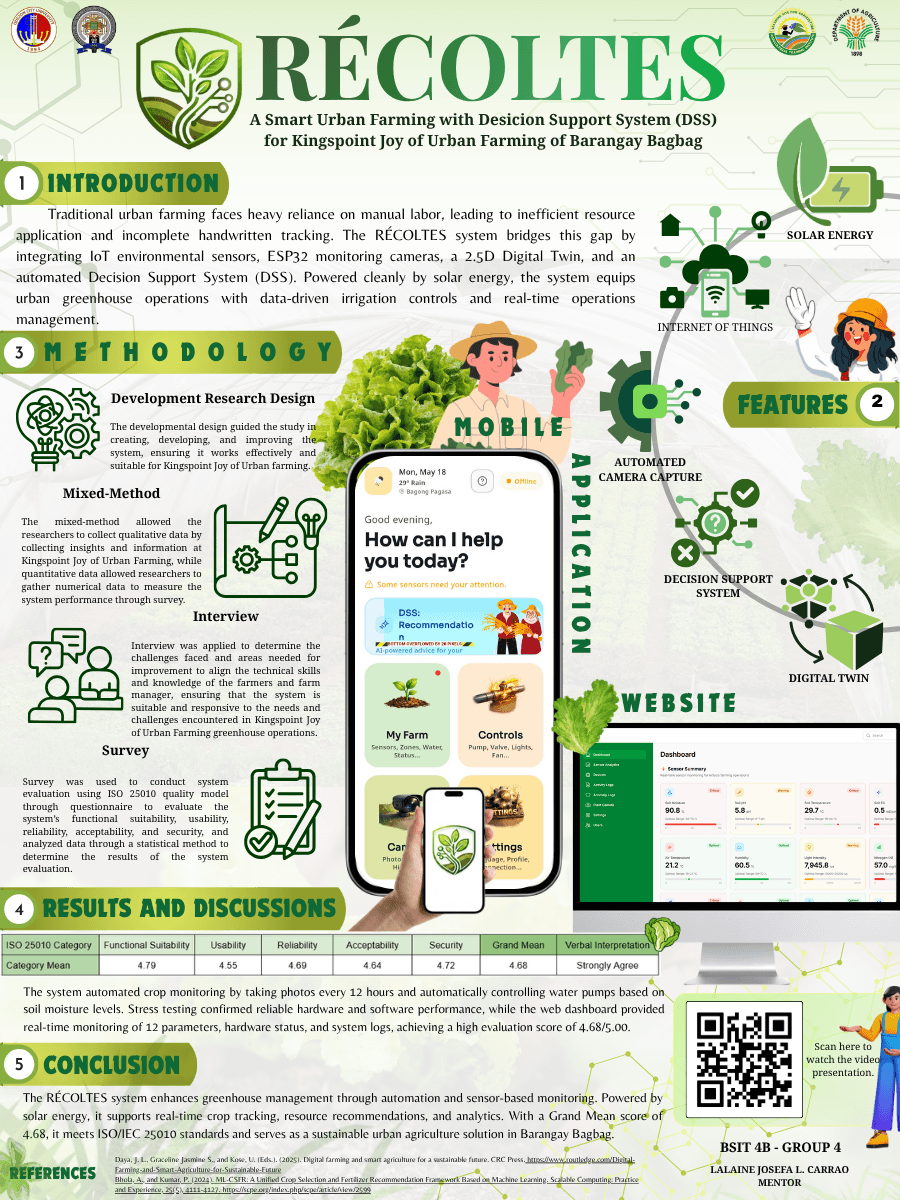
ISO/IEC 25010 Score
4.68 / 5.00
Sensors Monitored
12 Parameters
Actuators Controlled
6 Outputs
System Overview
01. IoT Sensor Network
ESP32 microcontrollers interface with a sensor mesh monitoring 12 environmental parameters — soil moisture, temperature, humidity, light intensity, NPK, pH, EC, water flow, and rain detection — publishing readings via MQTT at 30-minute intervals into PostgreSQL.
02. 2.5D Digital Twin
A real-time 2.5D visual mirror of the greenhouse renders live sensor states and actuator statuses. The mobile app's 'My Farm' view displays the digital twin alongside health scores and active alerts, giving operators an at-a-glance understanding of crop conditions.
03. Decision Support System (DSS)
An AI-powered DSS analyzes incoming sensor data and generates actionable recommendations for irrigation scheduling, nutrient adjustments, and environmental corrections. Recommendations surface directly in the mobile app and web dashboard.
04. Mobile App & Web Dashboard
The mobile app provides push notifications, sensor readings, manual pump/valve controls, and a camera feed for remote monitoring. The web dashboard delivers real-time parameter graphs, hardware status panels, and system logs across all connected devices.
05. Automated Camera & Solar Power
ESP32 cameras capture crop images every 12 hours for growth tracking. The entire system runs on solar energy, ensuring off-grid, sustainable operation within the Barangay Bagbag greenhouse facility.
06. ML Forecasting (RecoltesAPI)
A companion Python/FastAPI service hosts per-sensor gradient boosting models (XGBoost, LightGBM, HistGB) trained with 89 engineered features. The best model achieves R² = 0.9765 on soil moisture prediction, informing the DSS's proactive irrigation recommendations.
Technical Specifications
v2.0.0Core Stack
Performance Metrics
Results
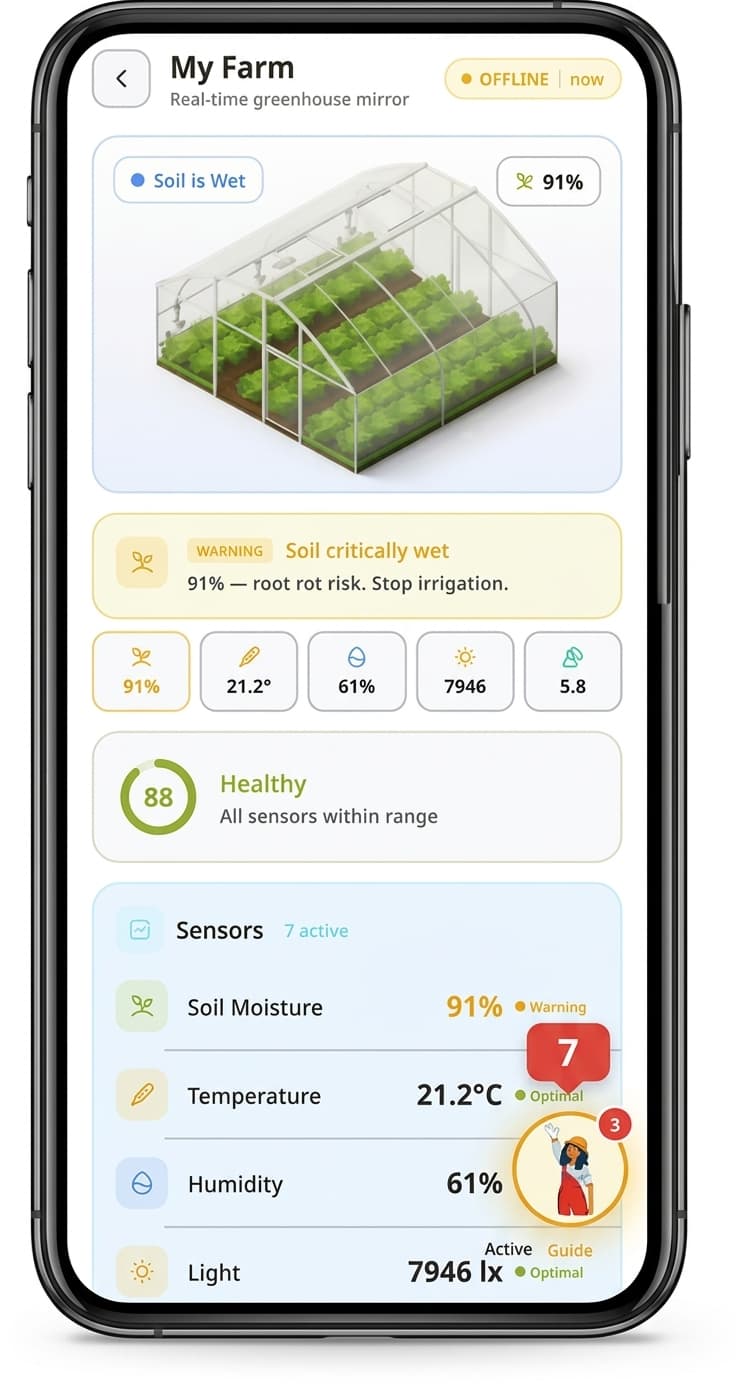
Mobile App — My Farm: Real-Time Greenhouse Digital Twin
The 'My Farm' screen renders a 2.5D isometric digital twin of the greenhouse alongside live sensor data from active sensors. A DSS warning fires when soil moisture hits 91% (root rot risk), automatically recommending irrigation stop. Health score: 88 — all sensors within range.
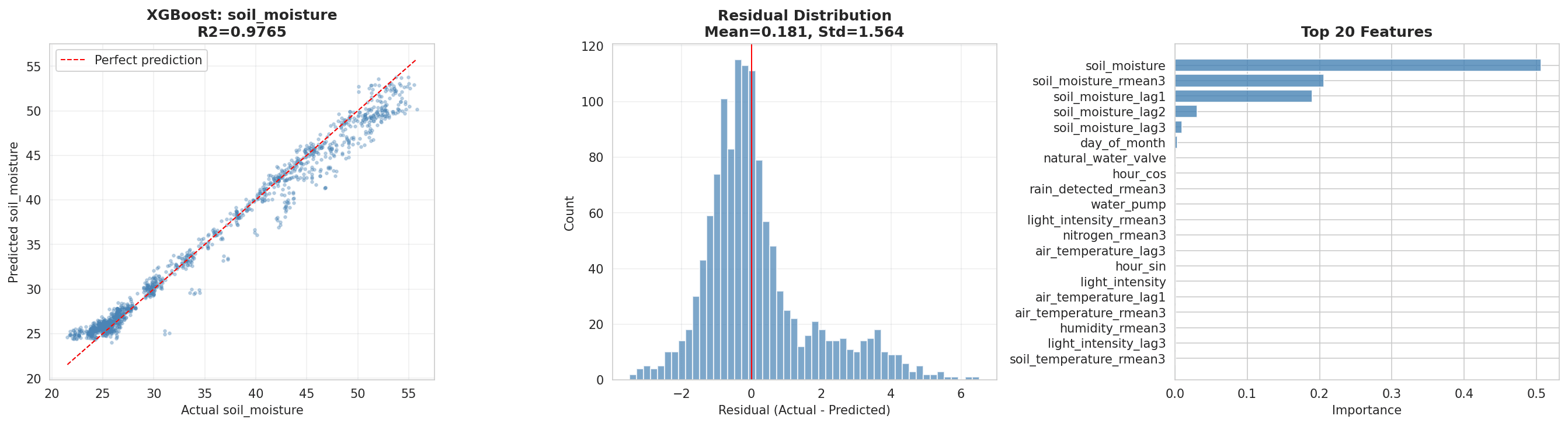
ML Module — XGBoost: Soil Moisture Prediction (R² = 0.9765)
A companion Python/FastAPI service (RecoltesAPI) hosts per-sensor gradient boosting models that inform the DSS's proactive irrigation logic. XGBoost achieves the best R² of 0.9765 with feature importance dominated by the target's own lag values, confirming the irrigation-driven temporal dynamics.
Core Architecture
IoT Sensor & Camera Mesh
ESP32 units coordinate a sensor mesh covering 12 environmental parameters and automated camera capture every 12 hours. All data flows through an MQTT broker into PostgreSQL, forming the foundation for the digital twin and DSS.
MQTT / ESP32
Digital Twin & DSS Engine
A 2.5D digital twin mirrors live greenhouse conditions in the mobile app. The AI-powered DSS processes sensor streams to generate real-time irrigation controls, pump commands, and crop health recommendations surfaced to operators.
Digital Twin / AI DSS
Mobile App & Web Platform
The mobile app delivers real-time sensor readings, DSS recommendations, manual actuator controls, and digital twin visualization. The PHP/Blade web dashboard provides parameter graphs, hardware status, and full system logs.
Mobile / Web